Showing posts with label book. Show all posts

Thursday, May 26, 2011

Finding Foragables in Peculiar Places


My interest in foragable foods has been increasing lately, and each time I learn of a new plant that is edible, I begin seeing it everywhere. It started two years back when I learned about Pineapple Weed from reading the blog Fat of the Land. Then a trip to the farmers market revealed that Japanese Knotweed is edible, and particularly good when it first sprouts - looking and tasting a bit like a hybrid of asparagus and rhubarb. Each time, I start seeing the plant at every turn, and often in the oddest places. Cracks in the sidewalk seem to be a particularly good environment for many Seattle edibles - including both the aforementioned plants, plus dandelion and plantain.

With three extra mouths to feed, learning which of the plants growing in and around our yard can be consumed means free food for the chickens (and us), so I decided this year I'd make a more concerted effort. I bought a copy of the paperback Fat of the Land: Adventures of a 21st Century Forager (by the same author, Langdon Cook, as the blog), and a 1970's classic, Northwest Foraging, by Doug Benoliel.

Neither includes photos, but by cross referencing the species mentioned with good ol' Google, I'm beginning to build on my knowledge of foragables in the area and their culinary uses, and am again seeing them at every turn.

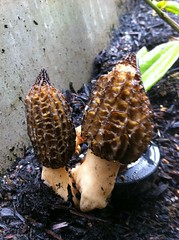
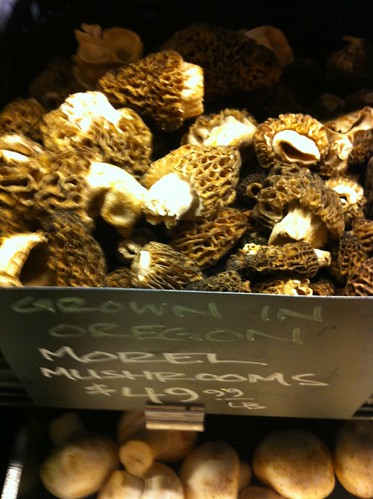
Case in point: the Morel Mushrooms I discovered growing in the garden beds at my brand new office building. I walked by them a couple times wondering if they could possibly be what I thought they were, but disbelieving that such a coveted edible, which pulls in $50 per pound at Whole Foods down the street, could possible be growing in a garden bed. After consulting with my friends Jason and Martha, dozens of web sites and even more photos, I confirmed they were in fact morels - lots of them - free for the picking. So I grabbed a few on the way home today.

Even though I was confident in my identification (there really aren't any mushrooms that are similar to a morel, and the closest are obviously different in key ways, such as not being hollow like a morel), I took advice I heard and read many places to cook it well (in butter), and eat only a small piece (a tablespoon or less) at first. Some people have bad reactions to even edible mushrooms, so a test is best.

The bite was meaty, buttery (no surprise there) and very satisfying. We'll eat some of the others, and save a couple to try to propagate a batch in our own yard. I hear they like apple trees, so maybe the overgrown behemoth that offers only an apple or two each year can finally help produce something tasty.


Sunday, June 6, 2010

Chicken Paprikash


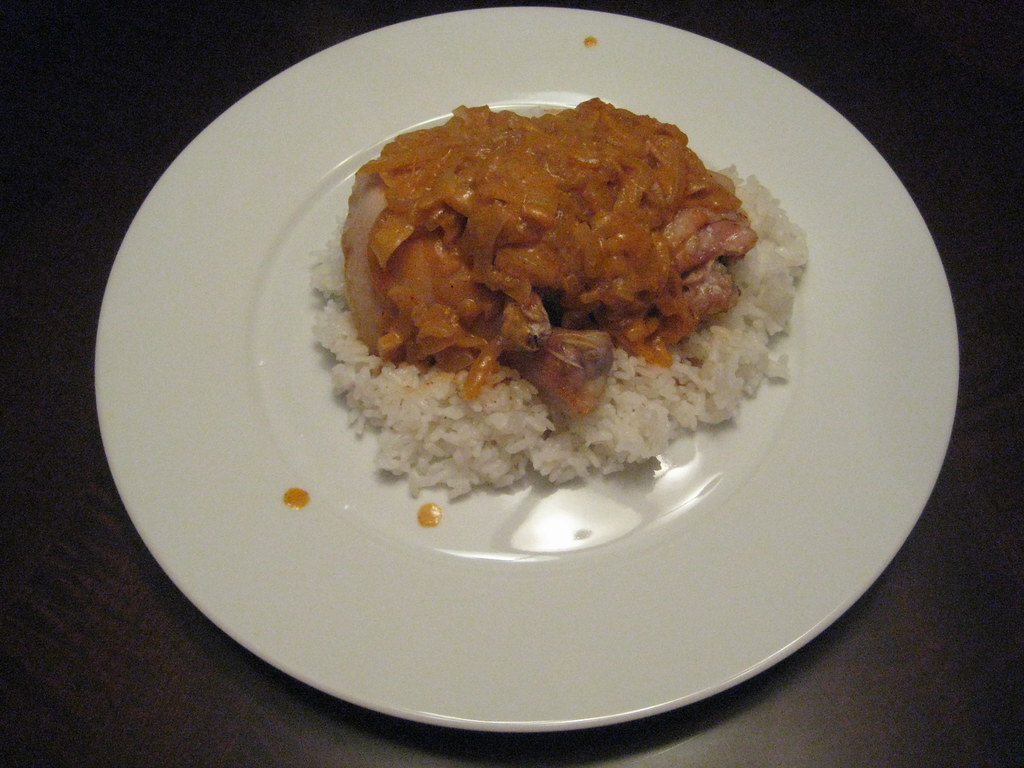
Dan found this great recipe for the Hungarian dish Chicken Paprikash, and tonight I gave it a go.

The first step is to break down your chicken into 8 pieces, which isn't included in the instructions. I relied on my copy of Knife Skills to walk me through the process. I did okay, except for the part where I tried to create a 9th piece using the tip of my thumb.

The dish ended up really simple to put together, relying on just a few basic ingredients and a single pot, and the flavors were surprisingly complex. We served it over rice.

Chicken Paprikash
1 whole chicken (about 3 1/2 pounds), cut into 8 pieces
1 Tbsp butter, softened
1 garlic clove, crushed
2 large onions, thinly sliced
1 Tbsp sweet Hungarian paprika
1/2 teaspoon salt
1/4 cup chicken broth
2 Tbsp sour cream

Preheat oven to 450°F. Pat chicken dry with paper towels. Mix butter with garlic. Use fingertips to spread mixture underneath the skin on the breasts and thighs.

In a small roasting pan, stir onions with paprika, salt, and 1/4 cup of water. Arrange chicken pieces in the pan. Cook chicken for about 10 minutes on 450°F, then lower the heat to 375°F and continue to cook an additional 30 minutes. Chicken is done when the internal temperature of the chicken reaches 175°F (use a meat thermometer), and the juices run clear when the thickest part of thigh is pierced with a knife. Note that breasts cook faster than the thighs, so you may want to take those out if done first, and let the thighs cook a few minutes longer.

Remove chicken pieces to a platter and let sit for 10 minutes. You may want to cut away the meat from the bones, and cut the chicken pieces into smaller pieces (entirely optional). Skim and discard fat from onion mixture in the pan. Add chicken broth to the onions. Placing the roasting pan on a stovetop burner, bring to boiling over medium heat, stirring to loosen the browned bits. Stir in sour cream. Serve chicken with onions spooned over it.


Friday, July 10, 2009

North Shore Hawaiian BBQ Delivers!


While driving home one day this week, Dan noticed that North Shore Hawaiian BBQ (in the odd triangular spot where Boren, 12th, and E Yesler converge) now has outdoor seating and a big Kona Brewing Co. sign.

That led him to checking out their web site, which is minimalist - but revealed that they deliver!


With so few delivery options in our neighborhood (Chinese, or Chinese, or Pizza, or Pizza) we were very excited to find a new delivery option for those nights we don't want to cook and can't be bothered to walk or drive anywhere. And it surely comes as no surprise that a Hawaiian delivery option was reason for serious celebrating at our house.


The menu is extensive, with a wide range of Local Food favorites from Hawai`i, including Japanese, Chinese, Korean, Filipino, and Portuguese dishes that have become part of the Hawaiian culinary landscape in the past century. We decided that we'd order a couple plates of food, and split everything so we could both try a lot of things - in the spirit of the plate lunch.

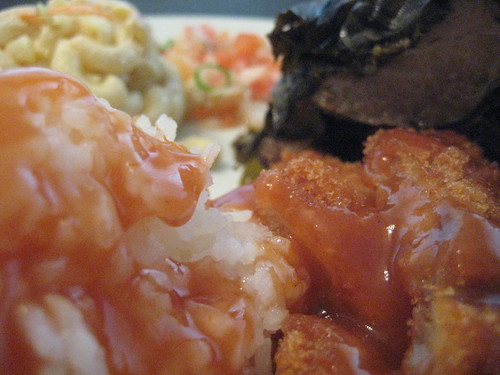
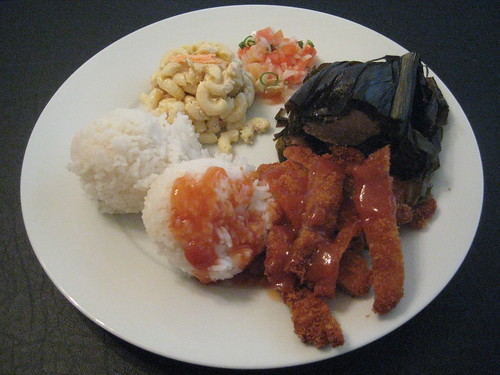
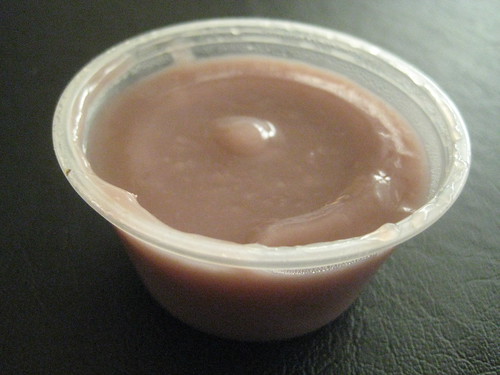
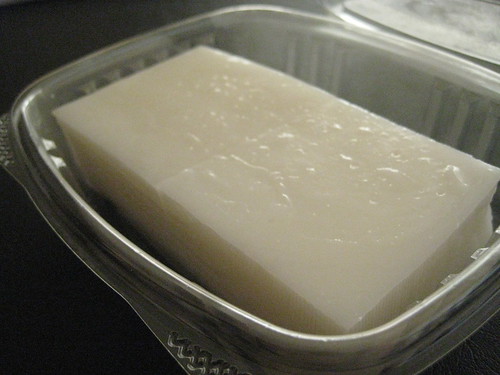
Dan got the Chicken Katsu (breaded fried chicken - $7.59) which came with 2 scoops of white rice and a scoop of mac salad. I ordered the ONO Special Plate with Pork Lau Lau (pork wrapped in taro leaves and steamed), with also came with 2 scoops of white rice and a scoop of mac salad, plus a small cup of lomi lomi salmon (diced salted salmon with tomato and onion), a small cup of poi (pounded taro root), and haupia (a jello-like coconut pudding) for dessert ($11.99). To push us over the mandatory $22 price point for delivery, we tossed on another order of haupia for $2.59.

Everything was pretty tasty, and it was nice to have some flavors of the islands after nearly a week away. The katsu was a little cold and tough, but still flavorful, and the poi had unfortunately become hot during the transport, so we popped it in the fridge for later.


I just began reading The Food of Paradise: Exploring Hawaii's Culinary Heritage by Rachel Laudan, which is an in-depth exploration of the history of local food in Hawai`i, starting with the current state of multi-cultural food (epitomized by the plate lunch) and moving back in time to cover the foods introduced by each of the many cultures that have found a home on the island, including the original Marquesan & later Tahitian mariners who settled the islands, the European & American influences that began arriving in the late 1700s and early 1800s, and the foods introduced by the waves of plantation workers that moved to the islands from Asia and Europe (primarily) starting around 1850.

I'm excited to learn even more about the history of the islands through their culinary traditions, and explore some of the foods I've yet to try via the recipes included - like bitsu-bitsu and squid luau (which I've shockingly never tried, let alone cooked).

Once I finish this book, I plan to dive into a thick, textbook style study of the Arts And Crafts Of Hawai`i, including the food traditions of the ancient Hawaiians.

Thursday, July 9, 2009

Shrimp Quesadillas & The Perfect Fruit


Dan picked me up from work today, and we swung by the store to get some tortillas, pre-cooked shrimp, and a tomato. With leftover pepper jack, onion, and avocado at home, I thought quesadillas would be a great way to use up those ingredients.

While we were at the store, I spotted the "plums" section of the produce area, and given that I just finished Chip Brantley's The Perfect Fruit - a book about pluots, I wanted to see if I'd learned enough to pick out a great tasting piece of fruit.

I was so excited when I looked at the labels and immediately recognized the farms from the book. David Jackson's Family Tree Farms seemed to be well represented, and happened to be one of the farms Brantley spent the most time visiting. One particular piece of fruit caught my attention - a nearly black, small, soft stone fruit with a dusty, slightly fuzzy surface. On it was a sticker indicating it was called a black velvet apricot, and was part of the Sugar Tree line - a variety of stone fruits exclusive to the Jackson family, who have been working to bring sweetness and flavor back to plums by working with breeders. The Sugar Tree line in particular represents exceptionally sweet fruit - as measured by their Brix rating.

At checkout, it put a little smile on my face to see the fruit's code ring up as a "plumcot", which is the term now being used for plum apricot hybrids because of marketing problems with the hard to pronounce "pluot" moniker.

Biting into my little black velvet fruit I could immediately tell the difference between this special little plumcot and commercial plums of my past. It was sweet, with a little tartness from the skin, and incredibly juicy.

I highly recommend checking out Brantley's book. It's really a love story, beginning with his first taste of a pluot, which sent him on a quest to find the source. He meets with breeders, farmers, and marketers, discovering the sometimes politically charged history of stone fruits, and discussing the challenges faced by the industry and changes brewing to try to improve that situation. His writing is a great balance of educational fact-finding and his personal experiences, sensations, and emotions along the way. Brantley does a great job of starting the book as an outsider, not even knowing how to say the word "pluot", and brings us along as he becomes something of an expert - ultimately imparting that wisdom to the reader along the way. Or at least, as much of it as can be gained without tasting hundreds of pieces of fruit first hand, walking the orchards, and shaking the hands of the farmers and breeders.

Sadly - I gobbled up the plumcot before snapping a photo, since I was so excited to try it. But you can be sure I'll be trying more this Summer.


Friday, June 26, 2009

Hawai'i Day Fourteen: Books and Beef


Breakfast today was my usual muffin, and lunch was a bit of leftover nachos from last night. In between and after we hit the Kapoho tidepools down the road and I spotted another moray eel - this one an adult the size of my arm. Tomorrow we're planning a drive over to the Kona side of the island in order to visit Pu'uhonua o Honaunau, which is having a Hawaiian Cultural Festival all weekend, so today we laid low at 'home', doing a lot of reading.

So far on the trip, I've finished two books - one today - both of which I've enjoyed, and both of which were (not surprisingly) food related.

The first was Meat: A Love Story by Susan Bourette, which follows the author's journalistic journey from a magazine assignment that has her working for a Canadian meat packing plant, to vegetarianism (briefly), to eating muktuk (whale) with Inuit, moose hunting, working in a Texas steakhouse & at a NY butcher shop, attending a raw meats buffet, and even volunteering at Stone Barns Center for Food and Agriculture - the community-based, 'back-to-basics' farm that (in part) supports the restaurant of Dan Barber, Blue Hill Farm, which you might've seen on one season of Top Chef.

Her writing is sharp and the prose is fast paced, and the fact that she was able to get herself invited or at least allowed into the placed she did is admirable. The only thing that kept bothering me while reading the book was the recurring theme of her being very, very bad at everything she tried to do. From being so bad at breaking down chicken that she's assigned to wrap meat in paper at the Pizzuco's butcher shop, to falling to the ground (and getting kicked out) of the kitchen at Pappas Bros. Steakhouse. It seemed to happen every chapter, every challenge she faced. And it got a little old to me. It came across at times as comical, but usually seemed a self-deprecating type of humor usually put forward by those lacking self-confidence, looking for others to build them up. It may have been the truth, but it seemed played up, and after ten chapters of it, seemed almost anti-feminist: a 250+ page declaration of how bad this woman is at "man's work". But still a good read, particularly for anyone wanting as much insight into the world of meat that they can get their hands on.

The book I finished today was Coop: A Year of Poultry, Pigs, and Parenting by Michael Perry. As the title suggests, it's the memoir of the author's experience returning to farming in his adult life, after a childhood growing up on a farm. I think it's really well written, weaving memories of the past with his 'present' experiences. It made me laugh out loud several times, and repeatedly had me in tears.

Interestingly enough, this author also admits his inadequacies boldly - and they're illustrated in several building projects he finds a way to mess up. Perhaps the fact that this is a memoir creates the balance necessary for those moments to not paint him as incompetent, but I think the difference is that Perry writes about those mistakes in a way that shows how focused and mindful he was of trying to do the right thing, but just not getting it right, whereas Bourette comes across as not paying attention, doing things half-heartedly, and thus failing. I think that's why the moments of self-deprecation in Perry's book came across as honesty whereas I question the truth of Bourette's falls and failures.

I started a third book, called Buddhism of the Heart: Reflections on Shin Buddhism and Inner Togetherness by Jeff Wilson, but didn't find it to my liking. My first introduction to Shin Buddhism, aka Pure Land Buddhism, was in Saltwater Buddha: A Surfer's Quest to Find Zen on the Sea by Jaimal Yogis, which Dan & I both read and enjoyed very much recently. In it, Yogis mentions how he didn't 'get' Pure Land Buddhism until one day when he realized he was already in the Pure Land. That made me curious about the tradition, but reading Wilson's writing on Shin makes me think Yogis was applying his Zen beliefs to the Shin tradition. Assuming Wilson - an assistant professor of religious studies specializing in Buddhist traditions and Shin practitioner - is a more reliable source for information on Shin than Yogis, it feels too dogmatic and, well, religious for me. What I love about the Buddhist traditions I've studied is the philosophical structure, the lack of pomp and circumstance, and the absence of mystical other-worlds, gods and monsters. Coming from that angle, Shin comes across as almost Christian, with it's core belief in the 'Pure Land' that you'll go to when your earthly body is no more. Perhaps I need to read more to understand it better, but for now, I'm switching to another book.

I got an advanced copy of Chris Anderson's latest economic exploration, Free: The Future of a Radical Price, which looks at the use of a $0.00 price tag to actually make money, that I'm digging into now. His last book (The Long Tail) was an interesting investigation into how businesses (like Amazon.com, for example) were making money by selling small amounts of lots of things, as opposed to large amounts of a few things, because of changes in some of the fixed costs. I've been fascinated by free goods for years in many ways (from my introduction to the gift economy of Burning Man in 2002 to my recent everything's free yard sale), and am interested in models used (past and present) to make a living by giving things away.

Assuming I knock Free out before our time here is up, I'll be back to food related reading with The Perfect Fruit: Good Breeding, Bad Seeds, and the Hunt for the Elusive Pluot by Chip Brantley. I'd never heard of a pluot until trying one from Tiny's Organics last Summer, but the biology and genetics behind it are interesting to me, so it should be a fun read.


And now that my Summer reading is dissected completely, I should probably return to more solidly foodie matters - like what I made us for dinner.
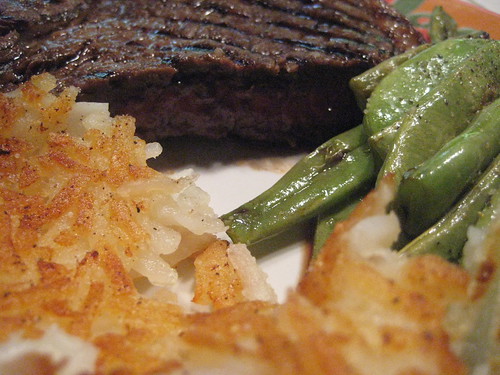


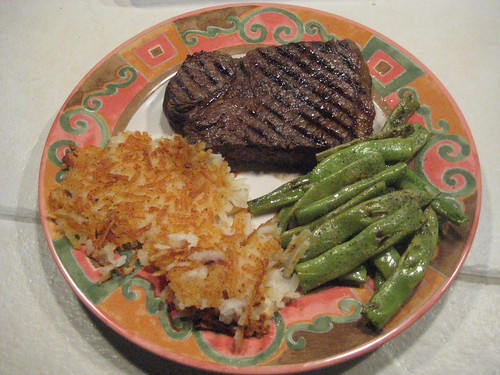
I began marinading a beautiful, grass-fed, locally raised steak yesterday in lots of ginger, garlic, and soy sauce, and tonight I seared it off on the grill, and served it with some grilled long beans we bought at the farmers market, and some pre-fab, frozen hash browns (a request from Dan, as he's been craving them). At first, I thought I'd mistakenly overcooked the beef - tasting a bite from the end that seemed beyond medium-rare, and noticing the depth of color of the meat. But then I realized the color was largely the soy sauce marinade having penetrated the meat, and (aside from the end bite) was seared on the outside but juicy and delicious in the middle. I dare say it was possibly my best steak cooking performance. So many years of vegetarianism have left me behind on learning to properly cook meat, but I may finally be getting the hang of it. Dan seemed to think so.


(Dan's writing all about our trip over at our other blog, The Dans In Hawai`i, so I'll just stick to writing what I know: food.)